Course Outline
Join PRO
Dark Mode
Join PRO to View Coaching

Break-even Point (Word Scrambles with Coaching)

Author:
Harold Averkamp, CPA, MBA

To see each answer, press or click the blue "Unscramble" button. For a short description and example, press or click the “View Coaching” button. If you have difficulty answering the following questions, read our In-Depth Explanation for this topic.

1. The break-even point occurs where total ___________ are equal to total costs.

REVENUES EESEURNV
REVENUES ENUEREVS
Unscramble

The break-even point occurs where total revenues are equal to total costs. At this point, the company is generating precisely the amount of sales to cover all of its expenses.

Example: If a company has $100,000 in total costs and is selling each of its product for $50 each, the break-even point in units would be 2,000 ($100,000 total costs / $50 revenue per unit). At 2,000 units sold, total revenues of $100,000 would equal the total costs.

2. Revenues minus variable costs equals the _________________ margin.

CONTRIBUTION BNORTICUIONT
CONTRIBUTION NCUNITOOTIRB
Unscramble

Contribution margin is revenues minus variable costs. The contribution margin represents the portion of sales which is available to cover the fixed costs and to generate profit after the variable costs have been paid.

Example: If a product sells for $100 and has variable costs of $60 per unit, its contribution margin is $40 per unit. This $40 is available to cover the fixed costs and then generate profits.

3. Costs and expenses which do not change in __________ when there is a change in volume are considered to be fixed.

TOTAL TTALO
TOTAL TTOLA
Unscramble

Fixed costs do not change in total with sales volume, whereas variable costs will increase or decrease in total when sales or some other activity changes.

Example: A company has a monthly fixed cost for rent of $5,000 and a variable cost of materials of $10 per unit. If they produce and sell 1,000 units, their total costs would be $15,000 ($5,000 fixed + $10,000 variable). If the volume is 1,200 units, the fixed costs will remain at $5,000 and the variable costs will be $12,000.

4. Costs and expenses that change proportionately with the change in volume are said to be ______________.

VARIABLE VELIRBAA
VARIABLE LRAAVIEB
Unscramble

Variable expenses are costs that change proportionately with sales, production volume, or some other activity. Variable expenses increase in total as more units are produced and sold, and decrease as fewer units are produced and sold.

Example: Direct materials is typically a variable cost. If it costs $20 in materials to make each unit, the total cost of materials will be $20,000 when 1,000 units are produced, or $40,000 when 2,000 units are produced. The total variable cost varies with volume, while the per unit cost remains the same.

5. The calculation of the break-even point in _________ uses the contribution margin per unit.

UNITS UISNT
UNITS NTUSI
Unscramble

The break-even point in units is the number of units that must be sold to cover total fixed and variable costs. It is calculated by dividing the total amount of fixed costs by the contribution margin per unit.

Example: If a company has fixed costs of $50,000 and a contribution margin of $25 per unit, the break-even point in units is 2,000 ($50,000 ÷ $25). They must sell 2,000 units to break even.

6. When calculating a product's break-even point in dollars, the denominator is the contribution margin __________.

RATIO AITRO
RATIO AIORT
Unscramble

The contribution margin ratio is the contribution margin expressed as a percentage of sales. The contribution margin ratio or contribution margin percentage is calculated by dividing the contribution margin per unit by the selling price per unit. It can also be calculated by dividing a company’s total contribution margin in dollars by the company’s total sales dollars.

Example: If a product has a selling price of $200 and a contribution margin of $80, the contribution margin ratio is 40% ($80 / $200). This means 40% of each sales dollar is available to cover the company’s fixed costs and profit.

7. When calculating a product's break-even point in dollars or in units, the numerator is the amount of __________ costs.

FIXED XDEIF
FIXED DIFEX
Unscramble

Fixed costs are the business costs that remain the same in total regardless of the level of production or sales.

Example: Rent on a production facility is typically a fixed cost. If rent is $3,000 per month, this cost remains the same in total whether 100 units or 10,000 units are produced that month. The total amount does not vary with volume within a reasonable range of volume.

8. A cost that is partly fixed and partly variable is referred to as a ____________ cost.

MIXED EIMXD
MIXED DEXMI
Unscramble

Mixed costs, which are also known as semi-variable costs, contain both a fixed cost component and a variable cost component. Part of the cost is fixed, while part of the cost varies with the activity level.

Example: A company’s electricity bill may have a fixed monthly service fee of $500 plus a variable cost of $0.10 per kilowatt hour used. The $500 is fixed, but the total bill will increase as production increases and causes more kilowatt hours of electricity to be used.

9. The "V" in CVP.

VOLUME ULOEVM
VOLUME EMVLOU
Unscramble

The “V” in CVP analysis represents volume. Cost-volume-profit (CVP) analysis looks at how changes in volume impact costs and profits.

Example: CVP analysis can help determine how many units must be sold to break even or to reach a desired profit. CVP is based on the relationships between the volume in units, fixed costs, variable costs, and selling price.

10. The excess of sales over the break-even point is the margin of ___________.

SAFETY AEYFST
SAFETY ETSAYF
Unscramble

The margin of safety is the amount by which actual or projected sales exceed the break-even point. It indicates how much sales can decline before losses begin.

Example: Assume the break-even point is $100,000 in sales. If the current sales are $150,000, the margin of safety is $50,000. This indicates that sales could drop by $50,000 before the company would be operating at a loss.

Access 1,800+ Premium Test Questions

Get Our Premium Break-even Point Test Questions When You Join PRO

Receive instant access to our entire collection of premium materials, including our 1,800+ test questions.

View All PRO Features
Mark Complete

Features

Free

PRO

Lifetime Access (One-Time Fee)
Explanations
Quizzes
Q&A
Dictionary
Bookkeeping Video Training
Financial Statements Video Training
Visual Tutorials
Quick Tests
Quick Tests with Coaching
Cheat Sheets
Flashcards
Crossword Puzzles
Word Scrambles with Coaching
Bookkeeping Study Guide
Managerial and Cost Accounting Study Guide
Certificates of Achievement
Bookkeeping Certificate of Excellence
Business Forms
Printable PDF Files
Bookmarks, Highlights, and Notes
Progress Tracking
Motivational Badges and Points
Motivational Medal Rankings
Motivational Activity Streaks
Public Profile Page of Achievements
Dark Mode

About the Author

Harold Averkamp

For the past 52 years, Harold Averkamp (CPA, MBA) has
worked as an accounting supervisor, manager, consultant, university instructor, and innovator in teaching accounting online. He is the sole author of all the materials on AccountingCoach.com.

Learn More About Harold

Read 3,034 Testimonials

PRO for Teams
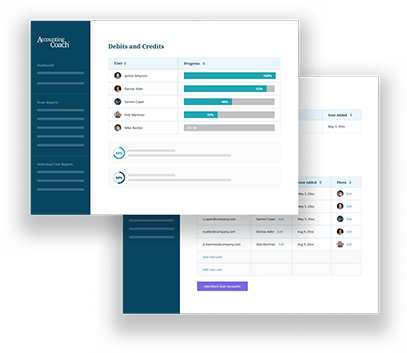
  • Easily add new users and team admins
  • Monitor individual user progress and grades
  • Monitor team progress and compare users
  • View average grades and find problem areas
  • Monitor recent activity and user achievements
PRO for Teams
Take the Tour Join PRO