Introduction
The income statement is one of the main financial statements of a business. Other names for the income statement include:
- Statement of income
- Statement of operations
- Statement of earnings
- Profit and loss (P&L) statement
- Consolidated statement of income (operations, earnings)
The income statement reports revenues, expenses, gains, losses, and the resulting net income which occurred during the accounting period shown in its heading. Typical periods or time intervals covered by an income statement include:
- Year ended December 31, 2025
- Year ended June 30, 2025
- Nine months ended September 30, 2025
- Three months ended March 31, 2025
- Month ended August 31, 2025
- 52/53 weeks ended February 1, 2025
The following is an outline of an income statement for a regular U.S. corporation:

Below are additional details for the lines in Example Corporation’s income statement:
Operating revenues are the amounts earned from the company’s main business activities. Common operating revenues are:
Operating expenses are the expenses associated with the company’s main business activities. Common operating expenses include:
Operating income is the result of subtracting the company’s operating expenses from its operating revenues.
Nonoperating revenues or income, nonoperating expenses, gains, and losses result from activities outside of the company’s main business activities. Common examples for retailers and manufacturers include investment income, interest expense, and the gain or loss on the sale of equipment that had been used in the business.
Income before income tax expense is the combination of the amount of operating income and the nonoperating amounts.
Income tax expense is the federal, state, and local income taxes relating to the amounts appearing on the income statement. (The actual amount paid will likely be different, since the amount paid is based on the amounts on the corporation’s income tax returns.)
Net income is the amount of earnings remaining after subtracting the income tax expense.
Notes to the financial statements refers the reader to important information that could not be communicated by the amounts shown on the face of the income statement.
Note:
If a corporation’s shares of common stock are traded on a stock exchange, the earnings per share and the average number of shares outstanding must also be shown on the income statement.
Additional details and examples of income statements will be provided later.
WATCH NOW
Advance Your Career with Our PRO Training
Accrual Method of Accounting
The financial statements distributed by U.S. companies must comply with the U.S. generally accepted accounting principles (GAAP or US GAAP). One of perhaps 1,000 rules in US GAAP is a requirement that the income statement be prepared using the accrual method of accounting.
accrual method of accounting is also referred to as the accrual basis of accounting, or accrual accounting. (The accrual method is different from the cash basis or tax basis.)
For the income statement, the accrual method means:
- Revenues are reported (recognized) on the income statement in the accounting period when they are earned, which is often different from the period when payment is received from the customers.
For example, if a company delivers products to a customer in December 2025 but the customer is allowed to pay in January 2026, the company will report the sale as part of its December’s revenues.
Common examples of revenues include the sales of products to customers and providing services for clients.
- Expenses are the costs and expenses incurred to earn the company’s revenues during the period of the income statement. It is common for an expense to be reported on the income statement in an accounting period different from when the company paid out the money.
For example, in June a retailer purchased and paid for products at a cost of $6,000. In July, the retailer sells the products for $10,000. There was no expense reported on the June income statement since none of the products were sold. (The $6,000 cost reduced the retailer’s cash and increased its inventory, both of which are reported on June’s balance sheet.) The retailer’s July income statement will recognize the expense cost of sales $6,000 as necessary to earn the $10,000 in sales.
Some costs will not be directly caused by sales and must be allocated. For example, a retailer may have purchased a delivery truck two years ago at a cost of $60,000. The truck was expected to be used for 60 months and have no salvage value. Therefore, every month for 60 months, the retailer’s income statement will report depreciation expense of $1,000.
Other costs such as salaries, advertising, rent, utilities, etc. have no future value that can be measured. Those costs will be reported as expenses when the costs are incurred or used up. In other words, July’s rent and utilities will be reported as an expense on the July income statement (even if the utilities used in July will be paid in August).
- A gain is reported on the income statement when a company sells a long-term asset for more than the asset’s book value. For example, if a company sells its old delivery truck for $10,000 and its book value was $6,000, the income statement will report a $4,000 gain on the sale of the truck.
- A loss is reported on the income statement when a company sells a long-term asset for less than the asset’s book value. If the company sells its old delivery truck for $5,000 and its book value was $6,000, the income statement will report a $1,000 loss on the sale of the truck.
- Net income or net earnings is the amount by which the income statement’s revenues and gains exceeded the amount of expenses and losses. A net loss is reported when revenues and gains were less than the amount of expenses and losses.
It is important to understand that the income statement’s focus is to report a company’s profitability during a relatively short time interval such as a month, three months, six months, a year, and so on.
The income statement does not report the company’s cash receipts and disbursements. To learn about the cash amounts, users should review the company’s statement of cash flows. (You can learn more about that financial statement by visiting our Cash Flow Statement Explanation.)
Example of an Income Statement
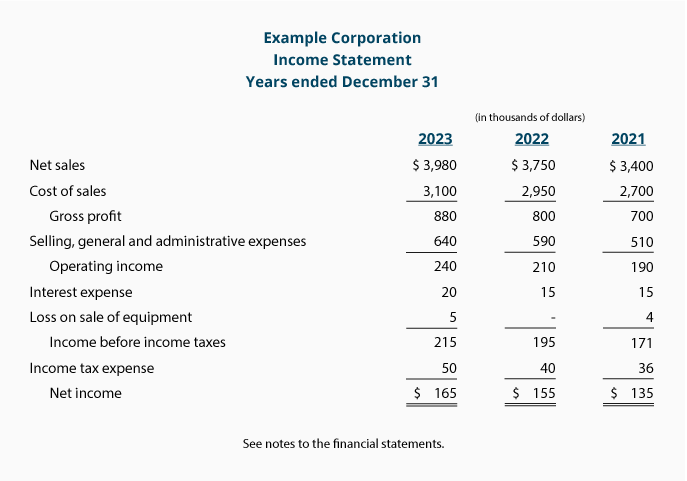
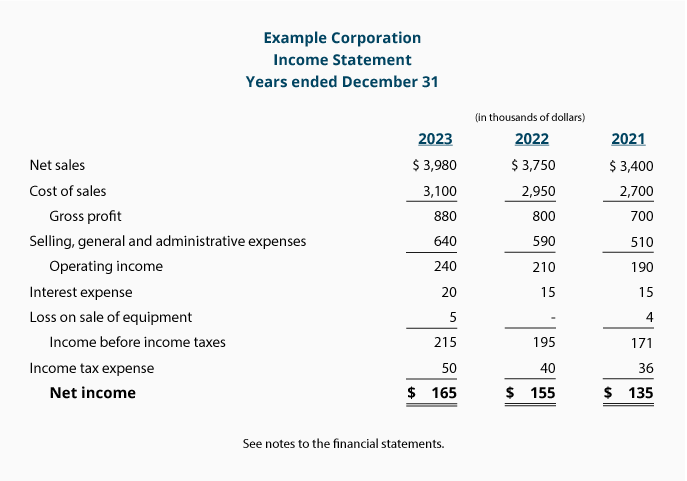
We will be referring to the following income statement for Example Corporation as we continue our explanation of the income statement.
Example Corporation is engaged in the purchase and sale of goods (products, merchandise). It is also a regular U.S. corporation which means the income statement will include income tax expense.

Income statement is one in a set of five financial statements
Reading only the income statement is not sufficient for understanding the financial activities of a business. Therefore, a business should distribute a set of five financial statements consisting of the following:
In addition to the above items, the set of financial statements must also include notes to the financial statements. The notes are important because the amounts on the face of the financial statements cannot adequately communicate the complexities of a business. To make readers of the income statement (or any other financial statement) aware of the significant information in the notes, one of the following sentences is shown near the bottom of every financial statement:
- See Notes to Financial Statements.
- See accompanying Notes to Financial Statements.
- See accompanying notes.
- The accompanying notes are an integral part of the financial statements.
- The accompanying Notes to Financial Statements are an integral part of this financial statement.
Comparative income statement
A comparative income statement displays three columns of amounts. This gives the reader two years of previous income statement amounts to put the most recent year’s amounts in perspective.
Since the column containing the amounts from the most recent year is the most relevant, it will be positioned closest to the descriptions. The column containing the oldest amounts is positioned furthest from the descriptions.
The heading of a comparative annual income statement will be changed to read “Years ended December 31″ (since three years of income statements are shown. The years will be indicated at the top of each column of amounts.

Rounding of amounts
Except for small companies, the amounts shown on the income statement are likely rounded to the nearest thousand or million dollars (along with a notation to inform the reader).
For example, the income statement of a large corporation with sales of $8,349,792,354.78 will report $8,349.8 and a notation such as (In millions, except earnings per share).
The income statement of a mid-size corporation with sales of $24,340,290.88 might report $24,340 and the notation (In thousands except per share amounts).
Rounding amounts is beneficial because it allows readers to focus on the most important digits. Omitting insignificant digits is also justified by the concept of materiality, because a lender or investor will not be misled without the least important digits.
Components of the Income Statement
Below we will discuss each section of the income statement starting with the heading.
Heading of the income statement
In addition to the name of the company and the name of the financial statement, the heading of the income statement informs the reader of the period or time interval during which the reported amounts occurred. Typical periods of time are a year, year-to-date, three months, one month, 52 weeks, 13 weeks, 4 or 5 weeks, and others.
In the U.S., the annual time periods or time intervals could be:
- A calendar year, which covers the 12 months from January 1 through December 31
- A fiscal year, which covers the 12 months that ends on a date other than December 31. An example is the 12 months from July 1 through June 30.
- A fiscal year, which covers a 52-week period (with a 53-week period every six years). An example is a retailer whose fiscal year ends on the Saturday closest to February 1. During the year, the retailer will have 4-week and 5-week periods instead of months and will have 13-week periods instead of quarters.
Net sales
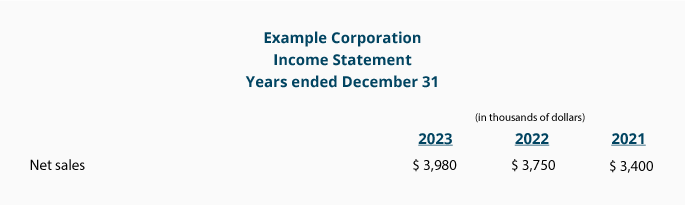
Net sales is the first amount shown on the income statement of a retailer, manufacturer, or other companies which sell products. In other words, sales are generally the main operating revenues for companies selling goods.

Net sales is the combination of the following amounts which occurred during the period shown in the income statement’s heading:
- Sales of goods, products, merchandise, etc. originally billed to customers
- Reductions for goods that were returned by customers
- Reductions for allowances granted to customers
- Reductions for customers paying the amount owed during a discount period
Sales are reported (recognized) on the income statement when the ownership of the goods passes from the company to the customer. In many companies this occurs before the customer pays for the goods. For example, if goods are sold to a customer in December 2025, but the customer is allowed to pay in January 2026, the amount of the sale is reported on the December 2025 income statement (and a receivable is recorded on the balance sheet at the time of the sale). When the customer’s money is received in January 2026, the receivable is removed.
Sales of goods, products, and merchandise are operating revenues for a company in the business of purchasing and selling goods. (If the merchant sells its old delivery truck, the amount received is not included in net sales since the merchant is not in the business of selling trucks.)
Cost of sales (cost of goods sold, cost of products sold)
The cost of sales, cost of goods sold, or cost of products sold is the company’s cost for the products that it sold during the period indicated in the income statement’s heading. The cost of the sales is the dominating operating expense for companies that sell products. No other operating expense will come close to a company’s cost of sales since it is often 60-80% of the net sales. Therefore, it is critical for the cost of the items sold to be calculated accurately.
The cost of sales is related to the cost of the items in inventory. If an error is made in counting or calculating the cost of the ending inventory, it is likely to cause the cost of sales, gross profit and net income to be incorrect.
A retailer’s cost of sales includes the cost paid to the supplier plus any other costs to get the items into the warehouse and ready for sale. For example, if a retailer purchases a product for $300 and pays an additional $20 of shipping costs to get the item into its warehouse, the cost of the product is $320.
A manufacturer’s cost of sales is the cost of producing the goods that were sold. This includes the cost of raw materials, direct labor, and manufacturing overhead related to the items sold. Determining the manufacturer’s cost of goods is complicated by the need to allocate the manufacturing overhead costs.
In the U.S., a company can select from several cost flow assumptions when calculating its cost of sales and ending inventory. However, the company cannot switch cost flow assumptions more than once.
You can learn more by visiting our Inventory and Cost of Goods Sold Explanation.
Gross profit
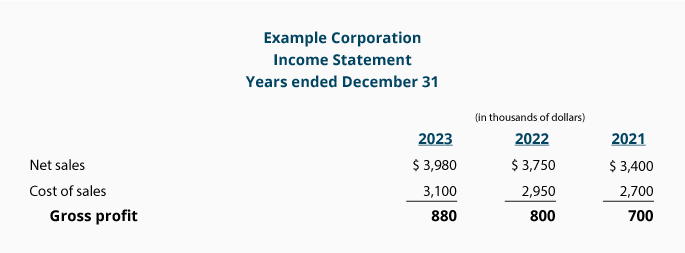
Gross profit (sometimes shown as gross margin) is the result of subtracting the cost of sales from net sales, as shown in Example Corporation’s partial income statement:

For any company to be profitable (have a positive net income), its gross profit must be greater than its selling, general and administrative expenses and nonoperating items such as interest expense.
Some people use the term gross margin to mean the gross profit percentage, which is the amount of gross profit divided by net sales. Expressing the gross profit as a percentage of net sales allows the company’s executives and financial analysts to see if the company was able to maintain its selling prices and gross profit percentages. The percentage also allows a company to compare its percentage to that of its competitors. Maintaining the gross profit percentages is often difficult because of pricing pressure from other companies, higher costs from suppliers, general inflation, and more.
The gross profit percentages (or gross margins) for Example Corporation have been improving as shown by the following calculations:
- Year 2025 was 22.1% = gross profit of $880 / net sales of $3,980
- Year 2024 was 21.3% = gross profit of $800 / net sales of $3,750
- Year 2023 was 20.6% = gross profit of $700 / net sales of $3,400
Selling, general and administrative expenses
The selling, general and administrative expenses are commonly referred to as SG&A.
For a retailer, SG&A include the salaries, wages, rents, utilities, depreciation of assets, advertising, insurance, and other expenses associated with the retailer’s primary activities, which are the purchasing and selling of merchandise.
[The expenses associated with secondary activities (such as the interest expense associated with its financing activities) are not included in SG&A. The interest expense and other nonoperating expenses will be shown on the income statement after the operating income is presented.]
A manufacturer’s main or primary activities include both the production and sale of its products. The costs in the production of the goods are included in the cost of sales (also known as the cost of goods sold). The manufacturer’s selling and general administrative expenses are reported as SG&A expenses similar to those of a retailer.
Both the manufacturer’s cost of sales and its SG&A expenses are operating expenses.
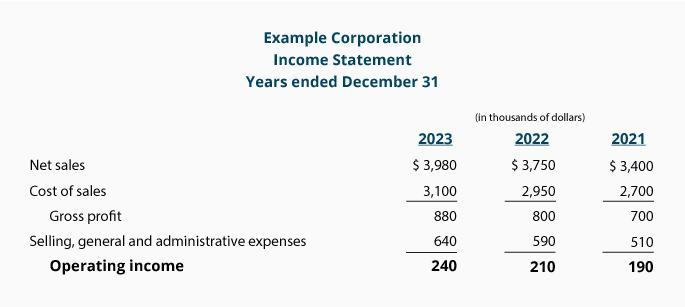
Operating income
Operating income = operating revenues – operating expenses
Example Corporation’s operating revenues are its net sales. Its operating expenses are its cost of sales and SG&A as shown in Example Corporation’s partial income statement:

Recall that the operating revenues for retailers and manufacturers are the amounts earned from its main activities including its net sales. The operating revenues of a service business are the amounts earned from its main activity of providing services.
The operating expenses are the expenses associated with earning the operating revenues and maintaining its operations. Operating expenses for a retailer and manufacturer are the cost of sales and SG&A expenses. Operating expenses for a service business are the cost of services and SG&A expenses.
Interest expense
Interest expense is a nonoperating expense for most businesses since financing is outside of their main activities of purchasing/producing goods and selling goods and/or providing services.
[Interest expense for a bank would be an operating expense, since the bank’s main activities involve paying interest to attract deposits that can be lent to borrowers to earn interest revenue.]
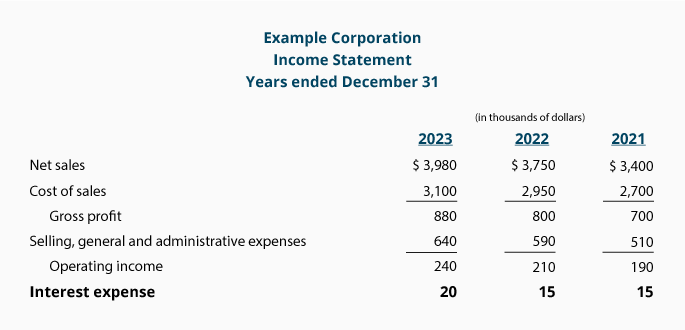
Since the interest expense incurred by retailers, distributors, and manufacturers is a nonoperating expense, it is presented after operating income as shown by hypothetical amounts in Example Corporation’s partial income statement:

Loss on sale of equipment
When a company sells or scraps a long-term asset that had been used in the business, the asset’s cost and accumulated depreciation must be removed from the company’s accounts. In its place will be the cash received for the asset.
Since the company is not in the business of selling long-term assets, the amount received is not included in its operating revenues. Instead, only the gain or loss on the sale is shown on the income statement after the operating income.
To illustrate, assume a company had purchased equipment 8 years ago at a cost of $70,000 and its accumulated depreciation on the date of the sale was $55,000. The combination or net of these two amounts is $15,000, which is known as the equipment’s book value or carrying value.
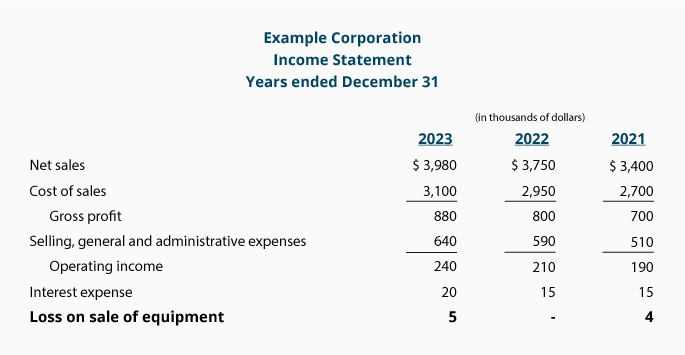
If the company receives less than the book value, the difference is reported as a loss on the company’s income statement. If the asset had a book value of $15,000 and the company received $10,000 the company will report loss on sale of equipment of $5,000.
You can see from Example Corporation that the loss is listed after the operating income on the following partial income statement:

[If the company had received cash of $18,000 for the old equipment with a book value of $15,000, the company would report a $3,000 gain on sale of equipment.]
Income before income taxes
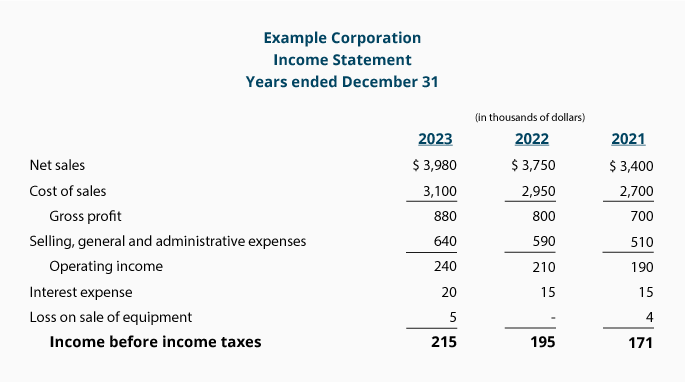
To arrive at the corporation’s income before income taxes or earnings before income taxes, the corporation’s nonoperating revenues and expenses, gains and losses on the sale of long-term assets, and “other” items are added/subtracted from the operating income as seen in the following partial income statement:

Income tax expense
Regular corporations (as opposed to other types of U.S. corporations and entities) must report on its income statement the amount of income tax expense that is associated with the items and amounts shown on the income statement. Typically there will be differences as to when the amounts will be reported on the income statement versus the corporation’s income tax return. As a result, the income tax expense shown on the income statement will not be the amount paid by the corporation for that year.
(The amount of income taxes paid by the corporation is available in the corporation’s statement of cash flows or notes to the financial statements.)
Net income
After subtracting the income tax expense, the resulting amount (referred to as the bottom line) is the corporation’s net income or net earnings. The net income for Example Corporation can be see here:
How Net Income Affects Stockholders’ Equity
A positive net income reported on a corporation’s income statement also increases the amount of the corporation’s retained earnings. Retained earnings is a separate item reported in the stockholders’ equity section of the balance sheet. Hence, the income statement and balance sheet are connected. (A net loss, or negative net income on the income statement decreases the amount of the corporation’s retained earnings.)
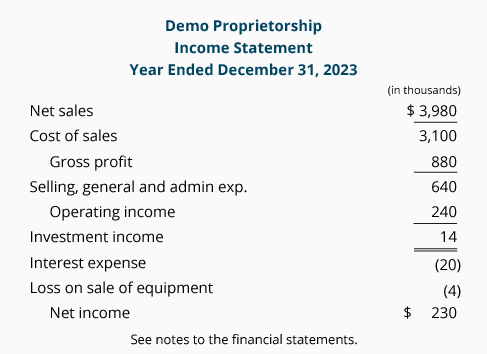
In the case of a sole proprietorship, the net income reported on the income statement will increase the owner’s capital account, which is part of owner’s equity. A net loss will decrease the owner’s capital account.
Statement of Comprehensive Income
The statement of comprehensive income contains a few amounts that are not reported on the income statement. These items are referred to as other comprehensive income.
The other component of comprehensive income is the net income reported on the company’s income statement. Therefore, the two major components of the statement of comprehensive income are:
- Net income (or net loss) from the income statement
- Other comprehensive income
The specific items that comprise other comprehensive income will be listed on the statement of comprehensive income. Items that commonly appear as other comprehensive income include the following:
- Foreign currency adjustments
- Unrealized gains/losses on pension and other postretirement benefit plans
- Unrealized gains/losses on hedging derivatives
How Other Comprehensive Income Affects Stockholders’ Equity
A corporation’s positive amount of other comprehensive income causes the corporation’s accumulated other comprehensive income to increase. (Other comprehensive losses cause the corporation’s accumulated other comprehensive income to decrease.)
Accumulated other comprehensive income is a separate item appearing in the stockholders’ equity section of the corporation’s balance sheet.
Here’s a Tip
- A corporation’s net income increases its retained earnings
- A corporation’s other comprehensive income increases its accumulated other comprehensive income
- Net income + Other comprehensive income = Comprehensive income
- Retained earnings and accumulated other comprehensive income are shown separately within stockholders’ equity
Additional Information Regarding the Income Statement
Owner’s compensation does not appear on a sole proprietorship income statement
The income statement of a sole proprietorship does not report an expense for the owner working in the business. The reason is that the owner of the sole proprietorship is not paid a salary. As a result, the net income of a sole proprietorship cannot be directly compared to the net income of a regular corporation where the owner is paid a salary.
For instance, assume that the income statement of a business organized as a sole proprietorship reported a net income of $100,000. The $100,000 reflects the combination of (1) the owner’s compensation for working in the business, and (2) the earnings of the business.
If the same business had been organized as a regular corporation and the owner/stockholder received a salary of $80,000, the income statement will report a net income of $20,000. The reason is that the $80,000 salary will be listed on the corporation’s income statement as salary expense.
Historical cost principle
The income statement amounts are generally based on the historical amounts at the time of the original transaction. (Changes in the fair value of marketable securities are an exception.)
To illustrate, assume that XXL Company’s office and warehouse building was constructed 20 years ago at a cost of $750,000 and was estimated to have a useful life of 25 years with no salvage value. Each year’s income statement will likely report depreciation expense of $30,000.
If the XXL Company or a competitor were to construct a similar building today, the cost might be $1,500,000 and the income statement will be reporting depreciation expense of $60,000.
What is the cost of using the facilities this year? Is it logical to match the costs from 20 years ago with the current year revenues? That’s what occurs because of the historical cost principle.
Average costs and opportunity costs
Some important costs are not shown in the income statement. Two examples are (1) the cost of making and selling one or more additional units of product, and (2) the cost of missing an opportunity.
To illustrate, assume that in a typical week Artisan Bread Company (ABC) produces 3,000 loaves of bread which will be sold for $7 a loaf. The cost of the ingredients is $1 per loaf and the other costs (bakers, rent, depreciation, etc.) are $6,000 every week regardless of the number of loaves produced. Therefore,
- If 2,000 loaves are produced, the average cost is $4 per loaf ($2,000 for ingredients + $6,000 of fixed costs = $8,000/2,000 loaves)
- If 4,000 loaves are produced, the average cost is $2.50 per loaf ($4,000 for ingredients + $6,000 of fixed costs = $10,000/4,000 loaves)
- The cost of making one additional loaf is $1 since the cost of ingredients is the only cost that will change
Now assume that ABC decides to sell its breads at a special event but is unsure of the number of loaves to produce. To avoid baking loaves that will not sell and lose the average cost, ABC decides to bake 100 loaves. It ends up that the 100 loaves were sold within an hour, and it becomes clear that an additional 200 loaves could have been sold. What was the cost of not producing 200 additional loaves? In other words, what was the opportunity cost or opportunity lost?
The cost of missing the opportunity to sell 200 additional loaves will never be listed on ABC’s income statement. However, we can compute the opportunity cost of not producing the 200 additional loaves:
- Additional revenues missed = $1,400 (200 loaves X $7 selling price)
- Additional expenses avoided = $200 (200 loaves X $1 of ingredients)
- Opportunity cost = $1,200 ($1,400 – $200)
Someone will say “Hindsight is 20/20! How would ABC have known?”
Well, ABC could have understood that the average costs of $2.50 to $4 per loaf were not relevant. In our example, the only relevant amount is the $1 per loaf cost of ingredients.
If ABC understood that by spending an additional $1 it could possibly earn $7, it may have produced more loaves. In other words, risking $200 in ingredients to potentially receive an additional $1,400 may have motivated ABC to produce more loaves. Looking at it another way, ABC would recover the additional $200 cost for ingredients by selling just 30 of the 200 additional loaves. After the 30 loaves are sold, ABC will be increasing its net income by $7 for each additional loaf sold.
Income Statements That Remain Inside the Company
The income statement format that we discussed and the requirement for issuing the set of five financial statements pertains to the financial statements that are distributed to people outside of the company, such as investors, lenders, financial analysts, etc. The financial statements that remain inside the company can be in a format different from those required by US GAAP.
More detailed and/or less complete
It is common for the internal income statements to contain schedules of expenses to support the amount of a company’s SG&A expenses. Some schedules will be limited to the expenses of a specific department such as IT, accounting, international marketing, human resources, etc. This allows each department’s manager to closely monitor its expenses without being distracted by the expenses of another department.
Income statements can also be prepared for a company’s major segments, such as the consumer products division and the industrial products division. Other formats are also possible.
Contribution Margin Format
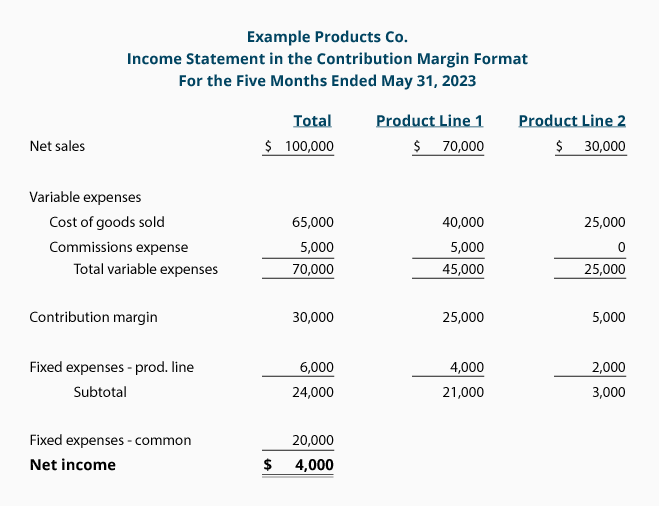
An internal income statement can be prepared to emphasize the contribution margin of a company’s products and product lines. The contribution margin examines the amount of net sales remaining after deducting only the costs and expenses that will vary in total as volume changes. Here is the concept in the form of an equation:
Contribution margin = sales – all variable costs and variable expenses
A brief example using hypothetical amounts in an income statement arranged in the contribution margin format is shown here:

After the contribution margin is shown, the $6,000 of fixed costs and fixed expenses that are directly traceable to each product line are subtracted.
The subtotal tells the reader the amount of profit that is available to cover the $20,000 of common fixed expenses. Common expenses means they have to be arbitrarily assigned to the product lines. Often the total amount of the common expenses will not decrease when a product line is eliminated.
The contribution margin format allows the company’s executives to see the relative profitability of its products or other segments. Seeing how profits will change when the volumes increase or decrease may be valuable.
Where to Go From Here
We recommend taking our Practice Quiz next, and then continuing with the rest of our Income Statement materials (see the full outline below).
We also recommend joining PRO to unlock our premium materials (certificates of achievement, video training, flashcards, visual tutorials, quick tests, quick tests with coaching, cheat sheets, guides, puzzles, business forms, printable PDF files, progress tracking, badges, points, medal rankings, activity streaks, public profile pages, and more).
Disclaimer
You should consider our materials to be an introduction to selected accounting and bookkeeping topics (with complexities likely omitted). We focus on financial statement reporting and do not discuss how that differs from income tax reporting. Therefore, you should always consult with accounting and tax professionals for assistance with your specific circumstances.

Earn Our Certificate
for This Topic
When you join PRO, you will receive instant access to 16 different Certificates of Achievement plus our Bookkeeping Certificate of Excellence.
View PRO Features